Please enter the code we just sent to whatsapp 91-11-46710500 to proceed
Didn't Receive OTP?
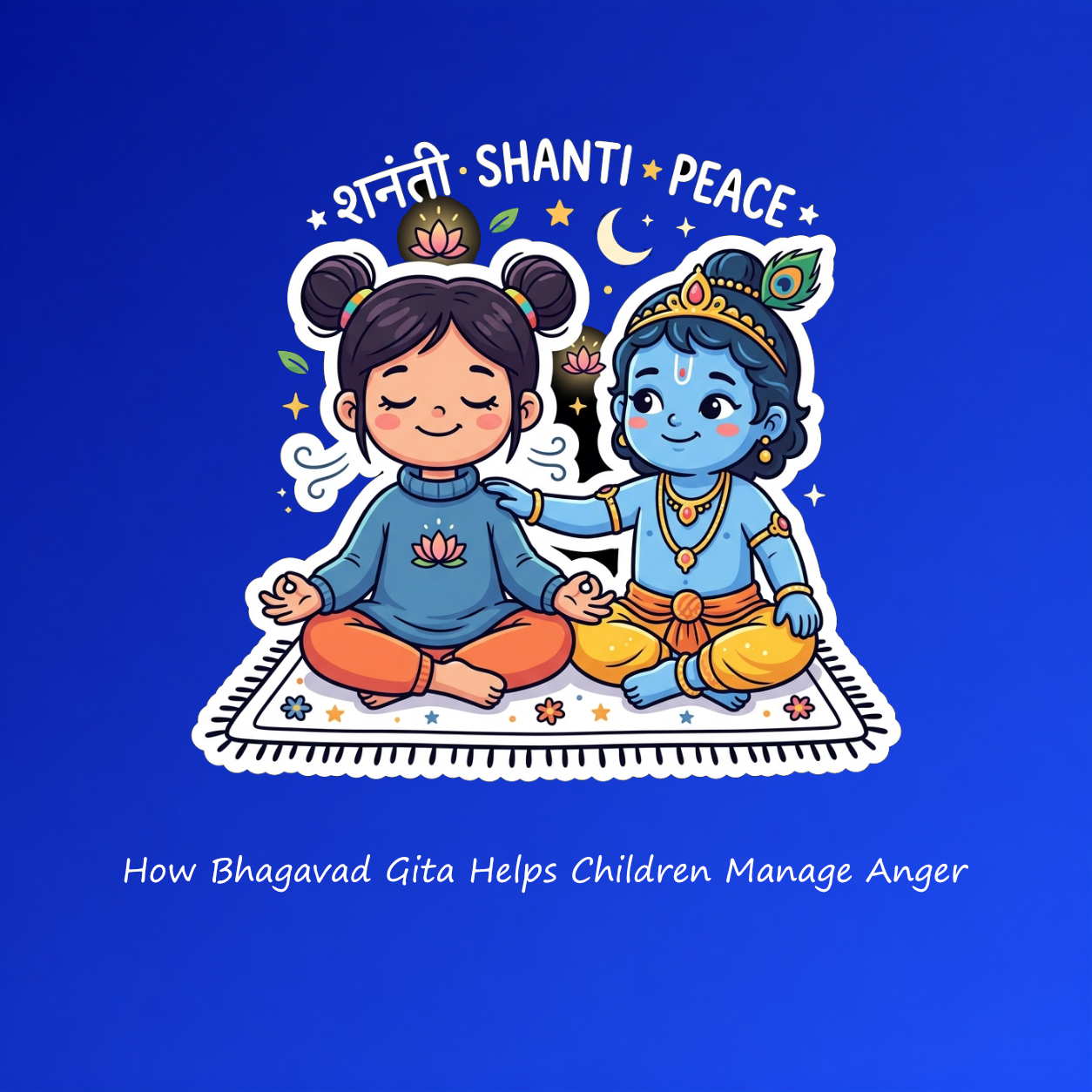
One of the many emotions experienced by kids is anger. Kids experience feelings of joy playing games, feelings of excitement discovering new things, and feelings of sadness in cases where everything goes wrong. Other than these positive emotions, there is one other emotion which poses problems for children, and that is anger. It could be conflict with siblings, failing at sports, or failing to get what they want. These cause issues for children in coping with emotions. In the current era where apart from academics, children should learn emotional intelligence as well, the lessons from Bhagavad Gita can be helpful in this regard. By teaching children how to react emotionally based on the teachings of Bhagavad Gita, children can learn how to cope better with emotions.
Anger through the Bhagavad Gita
One of the important lessons provided by the Bhagavad Gita is that even though emotions come as natural for humans, they should not allow them to rule their lives. One of the most common lessons about anger was stated in Chapter 2, verse 63:
"From anger comes delusion of the mind; from delusion of the mind, loss of memory; from loss of memory comes destruction; and from destruction, a descent into hell."
Using this particular lesson will help children to understand that becoming too angry may cause them to act thoughtlessly, say harsh words, break something or perform any other actions which later they may regret when they become more composed.
Learning this lesson will make children realize that becoming angry is not always a negative phenomenon, what matters is how one responds when becoming angry.
Stopping to Think before Doing Something
One of the many teachings in the Bhagavad Gita is self-restraint. Self-restraint teaches Arjuna how to be calm and always keep his composure.
Usually, when the child gets irritated and angry, he acts immediately. He could start screaming, crying, or even fighting, all within a moment's notice. The lessons from the Bhagavad Gita instill a sense of stopping to think about something before doing it.
The children could be taught the above lessons by their parents and teachers through:
• Taking some deep breaths when they are irritated and frustrated.
• Counting until ten.
• Suspecting the result of the action.
• Asking himself whether or not his actions will benefit him.
Emotional Intelligence Among Children
The emotional intelligence among children includes knowing about emotions, understanding emotions, and managing emotions. Self-awareness, as explained in the Bhagavad Gita, is another component of emotional intelligence.
When children have learned about emotions, they can react better when faced with difficult circumstances. They do not just exclaim, "I am angry." Instead, they learn how to express themselves like:
• "I feel hurt."
• "I feel disappointed."
• "I am frustrated."
By knowing the real cause behind such emotions, children find it easier to express their thoughts.
Teachings from the Bhagavad Gita help children become emotionally stable.
Detachment in learning about results
Children easily become upset if everything does not go according to plan. They are annoyed if they fail at any competition, achieve poor marks, and cannot get their favorite toy.
The principle of detachment in action is explained in the Bhagavad Gita via the direction in which people should concentrate their efforts. Krishna suggests that Arjuna act without being overly interested in the results.
It is crucial for one to inculcate such an attitude into children as they will learn that:
• It is not always about being successful.
• Error is inevitable, and people should make use of it.
• Success is not essential, only effort is important.
• Fear of failing is normal but meaningless.
Techniques of Mindfulness for Kids For kids, mindfulness is a process of becoming aware of the environment around them without getting into any emotional trouble. In this context, it must be noted that mindfulness techniques for kids are very similar to the ones used in the Bhagavad Gita that help in making sure that one’s mind remains calm. Some mindfulness techniques that can be adopted for kids based on Gita are as follows: Breathing exercises Kids can be told to take deep breaths when they are disturbed. Reflective thoughts Spend some quiet time each day and reflect on your surroundings. Exercise of gratitude Tell your kids to mention three things every day that they feel grateful for. Chanting shlokas Children can chant shlokas from the Bhagavad Gita.
Development of Empathy The anger in children arises from the realization that the child thinks only about himself. According to the lessons of the Bhagavad Gita, kindness and empathy towards others should be taught. As soon as children learn empathy, they begin taking into account the feelings of others. The result is that fewer conflicts arise among children, leading to peace being restored around the child. Some questions that can be used by the parents to reinforce this lesson include: • "How do you think your friend feels?" • "How would you feel if others acted in the same way as you are?" • "What is our approach towards solving this problem?"Creating a Positive Inner Dialogue
According to the teachings of Bhagavad Gita, controlling one's mind is essential. Sometimes children get angry because they engage in negative self-talk. Negative thoughts like:
• "I can't do this."
• "No one loves me."
• "It is not fair."
make children even angrier. According to Gita, one needs to change the negative thinking into positive affirmation and say to themselves things like:
• "I can try again."
• "I am getting smarter each day."
• "I can be calm and resolve the issue."
The change of the inner dialogue will contribute to the emotional strength of the person.
Why Bhagavad Gita Lessons Are Good for Children
Structured lessons on Bhagavad Gita will teach children how to control their anger. Children can develop many skills from storytelling, discussion, acting games, and studying shlokas.
As a result of attending lessons on Bhagavad Gita, children will learn how to:
• Recognize their emotions.
• Calm down and have self-control.
• Become confident.
• Show empathy and compassion towards others.
• Meditate and exercise mindfulness.
• Make wise decisions.
Children will learn how to respond instead of reacting.
Conclusion
Anger is a natural feeling; however, people have the choice to not let this feeling control their actions. The Bhagavad Gita is a perfect source for learning how to deal with feelings in the right way and make decisions based on them.
Thanks to it, people can gain essential skills that include mindfulness, emotional intelligence, empathy, and resilience. Therefore, the Gita gives all the needed information about the development of emotional intelligence and management of feelings for children.
By gaining these principles that the Bhagavad Gita states early enough, people will be able to cope with emotions and various obstacles much better in their lives. Every journey starts with one small step – a choice to respond intelligently.








 Unbox English
 Sanatan Unboxed
 Gita for kids
 Alpha Math